Wednesday, June 10, 2015
The Cinque Terre
June 10, 2015
The Cinque Terre — as this stretch of five towns along the Italian Riviera is called — is located in northern Italy between Pisa and Genoa. There’s not a museum in sight, just sun, sea, sand, lemon trees, grapevines and lots of tourists.
We camped at Levanto and took the morning train to Montorosso where we began a hike along the to the next town, Valparezza. It was fun, but also steep and challenging. Then we spent time exploring two other villages.
Until the advent of tourism in this generation, the towns were poor and remote. Today, tourism stokes their economies and each is well connected by hourly trains. But traditions are resilient, there’s not a chain store anywhere, and each of the five villages comes with a distinct dialect and its own proud heritage.
To preserve the Cinque Terre’s natural and cultural wonders, Italy has declared the region a park — towns and all. Visitors buy an inexpensive day pass to hike the scenic trail that laces together the unique communities.
One village we visited was Corniglia, with its mellow main square, the only one of the five not on the water. From the train station, a footpath zigzags up nearly 400 stairs to the hilltop town, but we took the little bus instead.
According to legend, a Roman farmer originally settled Corniglia, naming it for his mother, Cornelia, which is how Corniglia is pronounced in Italian. Residents claim Cornelia’s son produced a wine so famous that vases found at Pompeii touted its virtues.
You can see from the photos how lovely this place is. I really enjoyed it.
Monday, June 8, 2015
Florence III
View of the Duomo from the Palazzo Vecchio lookout tower.
View of the Duomo floor from high in the dome. See the people down there.
Single file moving up the narrow stairway to the dome. Not for the feint of heart.
At the top!
View of the painting in the ceiling cupola.
Another view of the Duomo and surrounding Florence from outside the lookout tower.
Rich on one of the exterior walkways of the lookout tower.
The Campanile from the Duomo dome viewing area.
Front and entrance to the Palazzo Pitti. Another grand art collection.
The rich frame indicates the kind of wealth held by the Medicis.
Exterior of Palazzo Pitti with a glimpse of the famous Boboli Gardens in the back.
I am in the outside hallway of Muses di San Marco. San Marco is a religious complex in Florence, Italy. It comprises a church and a convent. The convent, which is now a museum, has three claims to fame. During the 15th century it was home to two famous Dominicans, the painter Fra Angelico and the preacher Girolamo Savonarola. Also housed at the convent is a famous collection of manuscripts in a library built by Michelozzo.
Santa Maria Novella Church.
The crucifix is by Giotto.
The façade of Santa Maria Novella was completed by Leon Battista Alberti in 1470.
A find inside Florence's small archaeology museum.
Your everyday brass torch holders attached to the wall.
Exterior of the small archaeology museum.
Part of a divine mural in the Riccardi Palazzo.
Santa Maria del Carmine is a church of the Carmelite Order, in Florence. It is famous as the location of the Brancacci Chapel housing outstanding Renaissance frescoes by Masaccio.
The frescoes were begun in 1425 by artists Masolino and Masaccio.
Those by mostly Masaccio are The Tribute Money, St Peter Healing with his Shadow, The Crucifixion of St Peter, The Baptism of the Neophytes, and The Expulsion from Paradise.
Their treatment of figures in believable space made the frescoes among the most important to have come out of the Early Renaissance.
Adam and Eve getting kicked out of the Garden of Eden is a heartbreaker.
Bicycling home by the Arno was a blessing.
Friday, June 5
Uffizi
Bargello
Santa Croce Church
Galileo Museum
Saturday, June 6
Accademia
Museum of Precious Stones
Muses Deseo Innocente (orphan babies) Muses di San Marco
(Fra Angelico cells)
Duomo - climb dome
Palazzo Vecchio (Medici ruled from here.)
Palazzo Vecchio - climb lookout tower
Sunday, June 7
Palazzo Pitti (home of Medici across Arno River
San Francisco Cathedral
Small museum of Antiquities
Palazzo Riccardi
Bracucci Chapel
Florence II
1. The Accademia
(Galleria dell'Accademia) houses Michelangelo's David, the consummate Renaissance statue of the buff, biblical shepherd boy ready to take on the giant.
This is the star attraction.
2. In 1501, Michelangelo, a 26-year-old Florentine, was commissioned to carve a large-scale work. His creation, a 17-foot-tall symbol of divine victory over evil represents a new century and a whole new Renaissance outlook.
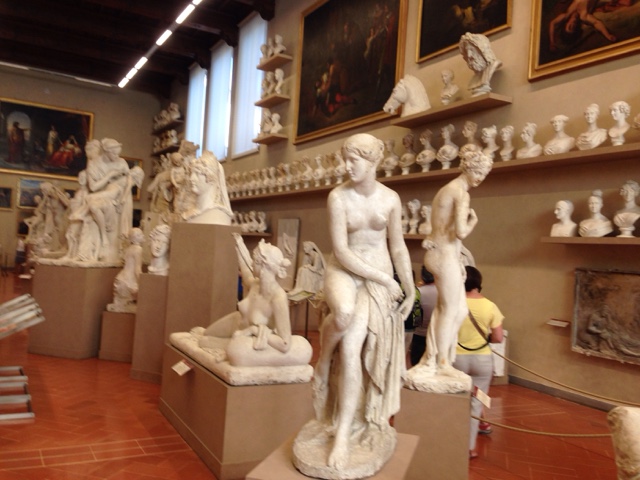
3. I liked this room full of statuary.
4. Portrait of a Young Girl, 1820, is one of the lovely works there.
5. Michelangelo's other unfinished works
Are in the Accademia including Prisoners and St. Matthew.
6. There was so much to see in the Accademia.
7. At a small museum of precious stone inlay we saw beautiful works such as this tabletop.
8. The malachite mantel caught my attention!
9. The artisans performed the exceptionally skilled and delicate task of inlaying thin veneers of semi-precious stones especially selected for their colour, opacity, brilliance and grain to create elaborate decorative and pictorial effects.
10. We visited the Ospedale degli Innocenti , 'Hospital of the Innocents', where people anonymously could give their unwanted babies to a place where they would be cared for and educated.
11. Designed by Brunelleschi (of Duomo done fame) who received the commission in 141, it is regarded as a notable example of early Italian Renaissance architecture. It was built and managed by the Silk Guild of Florence, one of the wealthiest in the city and, like most guilds, took upon itself philanthropic duties.
12. A close up of the Giovanni della Robbia sculpture behind me.
13. The Bargello, also known as the Palace of the People is a former barracks and prison, now an art museum. It has the best collection of Florentine sculpture.
14. Donatello's very influential, beautiful David was the first male nude sculpted in a thousand years.
15. Donatello who embraced realism with his lifelike statues, set the personal and artistic style for many Renaissance artists to follow.
16. Views of the Arno River bicycling to the campground at the end of each day.
(Galleria dell'Accademia) houses Michelangelo's David, the consummate Renaissance statue of the buff, biblical shepherd boy ready to take on the giant.
This is the star attraction.
2. In 1501, Michelangelo, a 26-year-old Florentine, was commissioned to carve a large-scale work. His creation, a 17-foot-tall symbol of divine victory over evil represents a new century and a whole new Renaissance outlook.
3. I liked this room full of statuary.
4. Portrait of a Young Girl, 1820, is one of the lovely works there.
5. Michelangelo's other unfinished works
Are in the Accademia including Prisoners and St. Matthew.
6. There was so much to see in the Accademia.
7. At a small museum of precious stone inlay we saw beautiful works such as this tabletop.
8. The malachite mantel caught my attention!
9. The artisans performed the exceptionally skilled and delicate task of inlaying thin veneers of semi-precious stones especially selected for their colour, opacity, brilliance and grain to create elaborate decorative and pictorial effects.
10. We visited the Ospedale degli Innocenti , 'Hospital of the Innocents', where people anonymously could give their unwanted babies to a place where they would be cared for and educated.
11. Designed by Brunelleschi (of Duomo done fame) who received the commission in 141, it is regarded as a notable example of early Italian Renaissance architecture. It was built and managed by the Silk Guild of Florence, one of the wealthiest in the city and, like most guilds, took upon itself philanthropic duties.
12. A close up of the Giovanni della Robbia sculpture behind me.
13. The Bargello, also known as the Palace of the People is a former barracks and prison, now an art museum. It has the best collection of Florentine sculpture.
14. Donatello's very influential, beautiful David was the first male nude sculpted in a thousand years.
15. Donatello who embraced realism with his lifelike statues, set the personal and artistic style for many Renaissance artists to follow.
16. Views of the Arno River bicycling to the campground at the end of each day.
Subscribe to:
Posts (Atom)