Sunday, June 7, 2015

Florence I

June 4, 2015

Florence's Duomo is the city's most iconic landmark. The square is mostly traffic-free so you can walk around and gape.

Capped by Filippo Brunelleschi's red-tiled cupola , it's a staggering construction whose breathtaking pink, white and green marble facade and graceful campanile (bell tower) dominate the medieval cityscape.

We did climb up into the dome! More on that later.


Palazzo Vecchio

It has the appearance of a fortress, topped by a huge open gallery, from which rises the slender tower known as the Arnolfo tower.

We climbed that, too.

Palazzo Vecchio, after having been the seat the seat of the town authorities, became the home of the Medici family.


Cosimo I de' Medici (12 June 1519 – 21 April 1574) was the second Duke of Florence from 1537 until 1569, when he became the first Grand Duke of Tuscany.


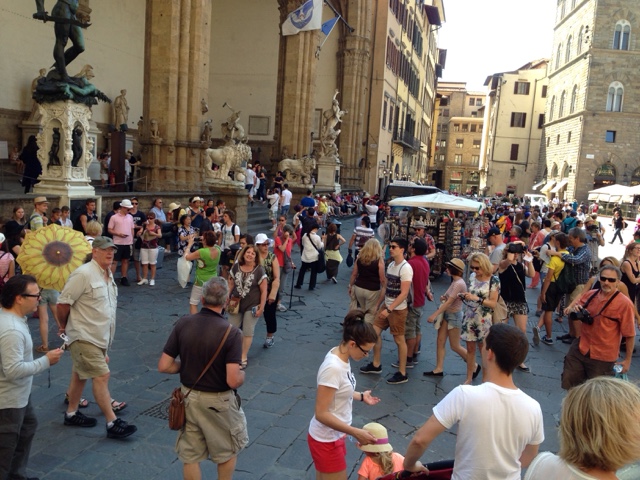
The Loggia Della Signoria is a unique example of an open-air sculpture gallery containing Antique and Renaissance art including this friendly lion.

The Loggia is across the square from the Palazzo Vecchio and statue of Cosimo.


Crowds enjoy the Palazzo Della Signoria.


In another area or Florence, visitors to Il Porcellino put a coin into the boar's gaping jaws with the intent to let it fall through the underlying grating for good luck. They rub the boar's snout to ensure a return to Florence, a tradition that the English literary traveller Tobias Smollett already noted in 1766, which has kept the snout in a state of polished sheen.


Ah, divine, that Duomo!


The Uffizi Gallery

This greatest collection of Italian paintings anywhere features works by Giotto, Leonardo, Raphael, Caravaggio, Titian, Michelangelo and Botticelli.

Around every corner is an "old friend", a painting that we know.

Some favorites:

The Adoration of the Magi (1423) is a painting by the Italian painter Gentile da Fabriano. The work, housed in the Uffizi Gallery in Florence, Italy, is considered his finest work.


The Holy Family with the infant St. John the Baptist known as 'Doni Tondo' 1507, by Michelangelo (1475 - 1564).

Tondo is Michelangelo's only recorded panel painting. The Holy Family has a sculptural quality. John the Baptist, looking on from behind a low wall, links the scene to the background in which a group of young male nudes adopt poses derived in part from Ancient statuary. The tondo was purchased by the Medicis in 1594.


The Madonna of the Goldfinch is a painting by Italian renaissance artist Raphael, (1505-1506). A 10-year restoration process was completed in 2008, after which the painting was returned to its home at the Uffizi in Florence.


Peeking out the upper storey windows of the Uffizi I saw the Ponte Vecchio.

Built very close to the Roman crossing, the Ponte Vecchio, or Old Bridge, was until 1218 the only bridge across the Arno in Florence.

The current bridge was rebuilt after a flood in 1345. During World War II it was the only bridge of six across the Arno that the fleeing Germans did not destroy. Instead they blocked access by demolishing the medieval buildings on each side.

On November 4, 1966, the bridge miraculously withstood the tremendous weight of water and silt when the Arno once again burst its banks.


Back to the paintings!

The Madonna of the Long Neck is an Italian Mannerist oil painting by Parmigianino begun in 1534.
It remained incomplete on Parmigianino's death in 1540.


Florence provides us free fizzy or plain water!


We rode bicycles to and from the campground along the Arno River everyday.

Tuesday, June 2, 2015

Ravenna

We are here in Ravenna for mainly this fact: its 1,500-year-old churches, decorated with best-in-the-West Byzantine mosaics.

Known in Roman times as Classe, the city was an imperial port for the large naval fleet. There is no longer a port here.

Sant'Apollinare is a basilica at Classe, about 3.6 miles from downtown Ravenna. (I know because we bicycled into town from here twice.)


Briefly a capital of eastern Rome during its fall, Ravenna was taken by the barbarians. Then, in A.D. 540, the Byzantine emperor Justinian turned Ravenna into the westernmost pillar of the Byzantine Empire. A pinnacle of civilization in that age, Ravenna was a light in Europe's Dark Ages. Two hundred years later, the Lombards booted the Byzantines out, and Ravenna melted into the backwaters of medieval Italy, staying out of historical sight for a thousand years.

Inside Sant'Apollinare.


The mosaics inside are important and included in the UNESCO listing for Ravenna. They show the transfiguration of Christ, St. Apollonaris with a flock of sheep and a charming landscape of flowers, trees and birds.


Ravenna's 1,400 year old Basilica di San Vitale with the most spectacular mosaics is downtown.


The Basilica di San Vitale, at 1,400 years old, is impressive enough on its own. But to see its brilliant mosaics still conveying the intended feeling that "this peace and stability was brought to you by your emperor and by God" is rare indeed.


There are scenes of apostles, the lamb on the twinkly ceiling, the beardless Christ astride a blue earth, and Emperor Justinian and his wife Theodora (an aggressive Constantinople showgirl who used all her charms to gain power with — and even over — her emperor husband) in their lavish court.

San Vitale can be seen as the last of the ancient Roman art and the first of the Christian era.


This church was the prototype for Constantinople's Hagia Sophia built 10 years later, and it inspired Charlemagne to build the first great church in northern Europe in his capital of Aix-la-Chapelle, now present-day Aachen, Germany.


The Mausoleum of Galla Placidia, just across the courtyard from the basilica, is the humble-looking little mausoleum with the oldest — and to many, the best — mosaics in Ravenna. The little light that sneaks through the thin alabaster panels brings a glow and a twinkle to the very early Christian symbolism (Jesus the Good Shepherd, Mark's lion, Luke's ox, John's eagle, the golden cross above everything) that fills the little room.


The Mausoleum of Galla Placidia alongside San Vitale is a surprisingly tiny building.

Galla Placidia was an important woman: born in around 390 AD, she was the daughter, sister, wife and mother of Roman emperors and had a full and colourful life. This building was built as her tomb; however she died in Rome.
The ceiling is a blue field of little gold stars, with a cross in the centre and symbols of the Evangelists at each corner.


The town's greatest mosaics have been given UNESCO World Heritage status.


Thanks to Rick Steves for his help with my storytelling.

Urbino


Before arriving in the beautiful Tuscan hills where Urbino is situated, we saw many bike riders along the way.

One friendly bike rider, Mauro, stopped to chat outside a grocery store. He told me that his father was taken prisoner of war by the Americans in WWII and kept in Texas for a year. He mentioned twice how his father was very well treated in the USA.


URBINO

Urbino is remote. You approach the city on tortuous two-lane roads that skim the margins of grain fields.

The town looks like something a Cubist craftsman assembled out of an infinite supply of buff-colored bricks — city walls, looming palace with dainty dunce-capped twin towers.


We parked outside the city wall and headed for the Ducal Palace, walking up steep slopes and through narrow streets lined with cafes, loud with students, finally emerging in the miraculous interior courtyard called the Cortile d’Onore, or Court of Honor.


It didn’t hurt Urbino’s reputation that Raphael, already a rising star and much in demand at noble courts, had been born right up the street from the Ducal Palace in 1483 and learned to paint there.

Florence was always far larger, Venice more extravagant, Rome more august, but for a few decades at the end of the 15th century and the start of the 16th, Urbino was truly the ideal city of the Renaissance.


After the gorgeous green of the surrounding countryside and the crabbed medieval cityscape, the cortile is like a crystalline equation.

White Corinthian columns joined by arches define a rectangle of noble proportions; Latin text inscribed in the stone proclaims the “justice, clemency and liberalism” of the palace’s builder, Duke Federico da Montefeltro, Duchess Elisabetta’s father-in-law.


DUKE FEDERICO, who lived from 1422 to 1482, was a fabulously successful condottiere — in essence a Renaissance mercenary — so feared that he was paid not to fight. He amassed a great fortune and lavished it on the finest artists and architects of the day.

Notice how he is dressed in armor while reading a book with his son at his knee in this painting by Berruguete, "Federigo da Montefeltro con il fillip Guidonaldo bambino".


In THE BOOK OF THE COURTIER, the author, Baldesar Castiglione, a diplomat to Rome, set out to define the essential virtues for those at Court. His book is a revealing window on to the ideals and preoccupations of the Italian Renaissance.

The ladies and gentlemen who strolled through this courtyard five hundred years ago would have been richly but soberly dressed, preferably in black — “more pleasing in clothing than any other color,” Castiglione wrote. “For my part,” intoned one of his fashion connoisseurs, “I should prefer [courtiers’ dress] not to be extreme in any way, as the French are sometimes in being over-ample, and the Germans in being overscanty.” They would have been graced with beautiful teeth (“very attractive in a woman”) but the good sense not to “laugh without cause solely to display”.

Even if the guests behaved only half as elegantly as Castiglione made out, it must have been quite a party. Certainly the setting was incomparable. Castiglione boasted (modestly) that Urbino’s ducal palace was “thought by many the most beautiful to be found anywhere in all Italy,” with “countless ancient statues of marble and bronze, rare paintings and musical instruments of every sort” and a vast library.

After an accident in which he lost an eye and broke his nose, the Duke would only permit his likeness in profile.


Sadly, two generations after Federico’s death in 1482, the Montefeltro family lost control of Urbino, and in time the bulk of the palace’s treasures and all of its books were carried off to Rome and Florence. Today, the visitor finds carved door lintels, ceiling medallions, fireplace mantels, a couple of chests and Federico’s huge painted box of a bed - all that remain of the original décor.
The variety of carvings is beautiful.


The one glorious room is the small private study in the duke’s suite — the Studiolo — a masterpiece of trompe l’oeil intarsia (inlaid wood) so ingenious and exact you’re tempted to pluck an apple from the basket of fruit.

Above the intarsia panels are portraits of great authors by Joos van Wassenhove.
The collection today was the special exhibition because several of these now belong to the Louvre but are here on loan
(This appears to be an ongoing source of dismay for Italians.) Federigo had these portraits to inspire him to do well.


The portraits include: Plato, St. Gregory, Aristotle, Ptolemy, Boethius,
St. Jerome, St. Ambrose, Boethius,
St. Augustine, Petrarch, Moses,
Dante, Solimon, Hippocrates, Pieteo d'Albano, Cicero,Seneca, Homer, Virgil, Aquinas, Duns Scotus,, Pius II, Euclid,, Bessarion, Vittorini da Feltre.


I thought the Duke might include my portrait so I made him a selfie.


William Butler Yeats, in a poem touching on those long-ago conversations, conjured up a room ...

“where the Duchess and her people talked
The stately midnight through until they stood
In their great window looking at the dawn.”

In March of 1507, in a lofty high-windowed room in a palace in Le Marche, a region of Italy northeast of Rome, the High Renaissance reached its pinnacle. For four successive nights, a company of poets, artists, scholars and nobles, assembled on the occasion of a papal visit, gathered around a table in Urbino’s magnificent Ducal Palace to chat about love, law, morals, manners, beauty, sex, seemliness, art, hats, cosmetics, tennis and whatever else most pressed the minds of Renaissance men and women.

These were the conversations that the diplomat Baldassare Castiglione recreated (and no doubt embellished) soon afterward in “The Book of the Courtier,” a kind of manual on how to be cool at court that for centuries afterward was required reading throughout Europe for all who aspired to a life of power and polish.

“Here, then, gentle discussions and innocent pleasantries were heard,” Castiglione wrote of the delightful ambience fostered by Elisabetta Gonzaga, the duchess who presided over the fabled gatherings, “and on everyone’s face a jocund gaiety could be seen depicted, so much so that the house could be called the very abode of joyfulness. Nor do I believe that the sweetness that is had from a beloved company was ever savored in any other place as it once was there.”

At a stroke of the quill, Castiglione made the windy little hill town of Urbino a byword for refinement, elegant nonchalance (sprezzatura was his word for it) and the perfect marriage of money and art.

This is the "Room of the Vigils" where the conversations took place.


The other rooms around the Court of Honor have been whitewashed and repurposed as a museum of medieval and Renaissance art.

La Citta Ideale by Luciano Laurana, 1430.

Urbino’s palace culture also gave rise to the first-ever painted images of utopian cities in the form of a trio of intriguing panels, all now known as “The Ideal City,” one of which remained in Urbino, the other two now being in Baltimore and Berlin.


The book gave me a lot to think about and in many ways is surprisingly progressive.


Were he to return from Renaissance heaven, Castiglione would surely judge our manners coarse, our conversation lacking in wit and our clothes unspeakable in the city he immortalized.

HINTS: DRESS DOWN AND DON'T SHOW YOUR TEETH

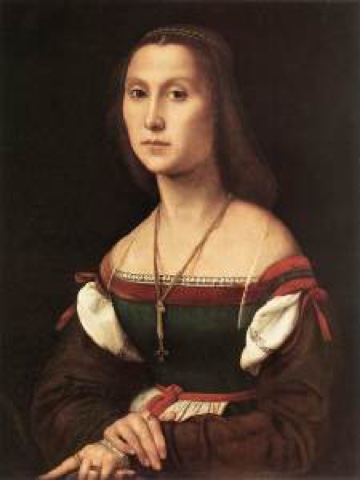
The collection’s masterpieces — Raphael’s incomparable portrait of a melancholy beauty, “La Muta,” and Piero della Francesca’s humble, dusky “Madonna of Senigallia” and surreal, puzzling “Flagellation of Christ” — are ghostly reminders of how dazzling this court once was.


David Laskin's NYTimes travel article is a source for this storytelling.

Bologna


Fusing haughty elegance with down-to-earth grit in one beautifully colonnaded medieval grid, Bologna is actually red, so they say, due to its terracotta colored buildings, and also known for its leftist politics.

We spent one afternoon here amidst the friendly, busy hordes of people.


Walking along, music rang out through this open door, and it turned out to be a real orchestra of mostly college-age people preparing for a concert.


Bologna takes pride in its culture as even details such as this pretty design board over a town planter is appealing.


This is a small section of a large board (outside in the huge plaza) of photos of those in the Resistance from Bologna in WWII.


Santo Stefano : According to tradition Saint Petronius, a bishop of the city during the 5th century, built the basilica over a temple of the goddess Isis. The saint wished to have a building that recalled the Church of the Holy Sepulchre in Jerusalem. There are four remaining churches of the seven built together here over the centuries.
As you can see people still worship here.